↳ Wine Cooler Repair
Sub-Zero Wine Cooler Fan Replacement: Signs, Parts and Who Does It
Wine cooler fan replacement is the swap of a worn evaporator or condenser fan motor that has begun to chirp, grind or stall, so air moves over the coils again. Here is how each fan fails, what you notice, and when a Sub-Zero needs a technician.
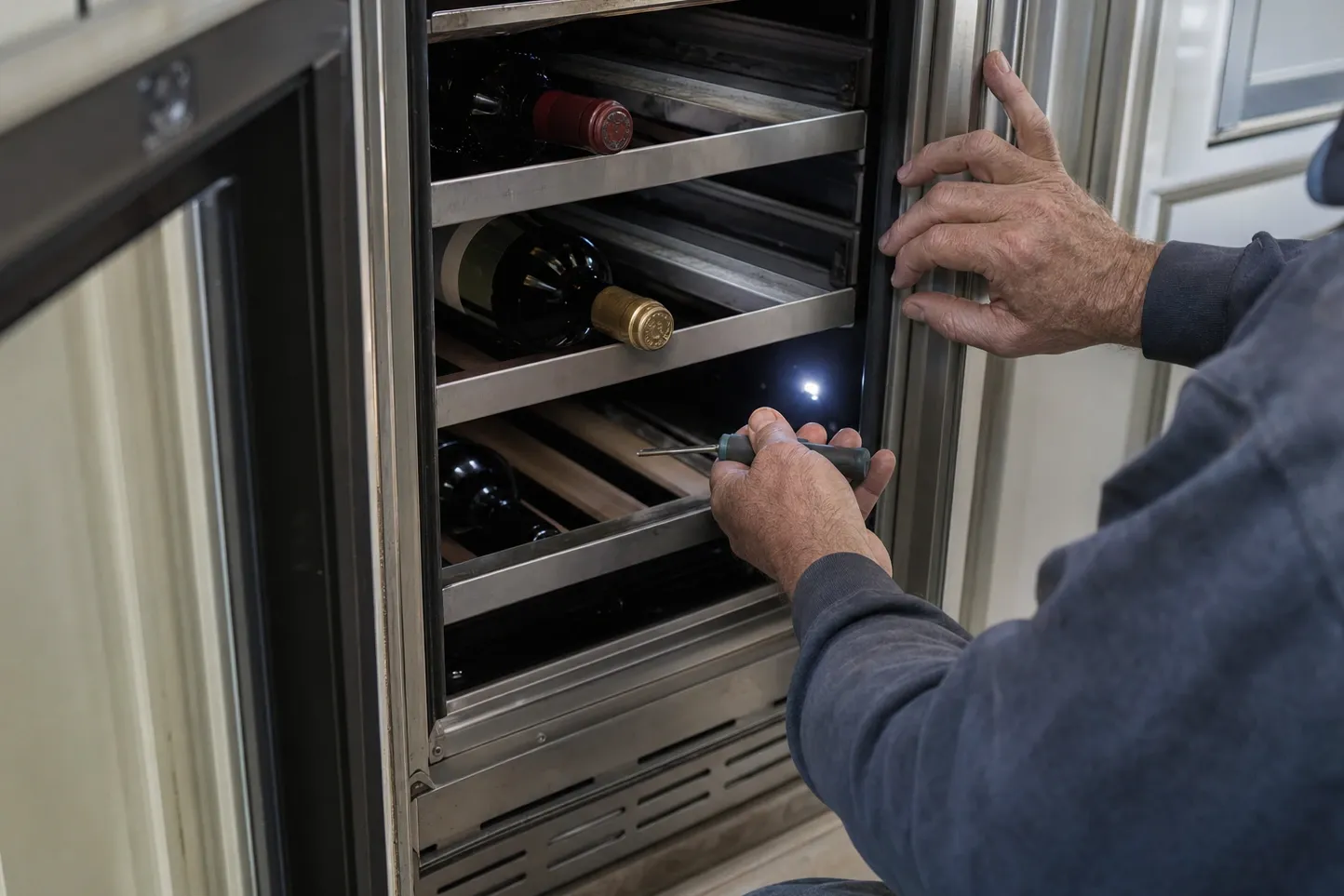
Wine cooler fan replacement means taking out one of the two small motors that keep air moving through the cooling system and fitting a matched new one. One fan sits inside the cabinet, usually behind the rear wall panel, and pushes chilled air past the bottles. The other lives in the machine compartment beside the compressor and pulls room air across the condenser. When either wears out you hear it before you feel it: a chirp, a tick or a gritty hum, then zones that creep warmer. On a small freestanding cooler the swap is an afternoon with a screwdriver. On a built-in Sub-Zero wine unit it is a technician visit, because the fan hides behind panels and must first be proven to be the fault rather than the control or the sealed system.
What the two fans actually do
A wine cabinet holds bottles at a steady cellar temperature, so the air has to keep moving evenly or one end of the rack drifts away from the setting.
The evaporator fan blows across the cold coil and out through the storage space, and in a dual-zone unit each zone can have its own air path. If this fan slows, the coil still gets cold, but that cold goes nowhere. The sensor near the bottles reads warm, the compressor keeps running, and frost begins to gather on the coil.
The condenser fan draws room air through the condenser so the refrigerant can shed the heat it collected inside. When it quits, the compressor runs hot and long, and the cabinet warms even though the machine sounds busy.
How a fan motor wears out
- Dry bearings. The usual ending: a thin whine or chirp, loudest just after the compressor starts, growing rougher over a few weeks.
- Blade contact. Frost on the evaporator, a rear panel knocked out of line, or a fan cover pushed in by a bottle lets the blade clip something, giving a rhythmic tick or scrape.
- Dust load. Lint and pet hair cake onto the condenser fan blade and coil, the motor labors, and it overheats early.
- An open winding or a poor connection. The fan simply stops, or, with moisture at a connector, works one day and sits still the next.
A still fan is not always a dead fan. The control board decides when to power it, and on many units it runs only with the compressor, so voltage at the fan plug is checked before any part is ordered.
Signs that point at a fan
| What you notice | Fan most likely involved | What else can cause it |
|---|---|---|
| Chirp, whine or tick inside the cabinet | Evaporator fan | Frost on the coil, loose rear panel |
| Rattle or grind from the outside grille | Condenser fan | Debris in the compartment, loose shroud |
| Cabinet warm while the compressor hums | Either | Dirty condenser, sealed-system fault |
| One zone warm, the other fine | Evaporator fan for that zone | The door seal on that zone |
What a Sub-Zero display may tell you
Sub-Zero controls rarely name a fan outright, but a failing fan creates exactly the conditions the alarms watch for.
- On 400 Series wine storage, EC 10 flags the upper cabinet running warm and EC 12 the lower one. Before booking service, Sub-Zero asks owners to confirm the room stays between 60°F (16°C) and 90°F (32°C).
- A 400 Series unit flashing Service has shut its cooling down after the compressor ran far too long. Turn it off, clean the condenser, check nothing props the door open, and turn it back on; expect normal temperature within 24 hours. A stopped condenser fan is a classic cause, so if Service returns after a cleaning, have the fan tested.
- On Designer Wine (IW) models, 40 1 09 means zone 1 has wandered well too warm or too cold. Cut the breaker for 30 seconds; if the code returns, book a visit, and the zone 1 evaporator fan is on the checklist.
Not every warm zone is a fan, though: a brand-new wine unit may pull down one zone at a time while it settles, and a warm cabinet can need a full 24 hours to recover after its condenser is cleaned.
DIY job or technician job
Many compact freestanding coolers use a standard square low-voltage fan held by four screws, and owners often swap it themselves. Unplug the cooler, photograph the wiring, and match the replacement on voltage, frame size, current draw, plug style and airflow direction; the arrow molded into the housing shows which way it blows.
A built-in Sub-Zero hides its fans behind interior panels or deep in a machine compartment framed by cabinetry. What an owner can safely do first:
- Switch off the breaker for the unit, wait 30 seconds and restore it to clear a one-off fault.
- Clean the condenser grille and coil if three months or more have passed since the last cleaning.
- Move any bottles touching the rear panel so the air path is open.
- With the door closed, listen for a minute after the compressor starts and note where the sound comes from.
Our wine cabinet repair service begins with those same checks plus a meter on the fan circuit. Replacing an evaporator or condenser fan motor typically runs $340–$720 with the part, and the firm number comes once diagnosis is finished; the evaporator fan motor replacement cost and condenser fan motor replacement cost pages break each job down. If the meter shows the board is failing to power a healthy fan, the repair becomes a control board instead, typically $420–$990. A single $89 charge covers the drive out and all of the fault-finding, and it is subtracted from the repair as soon as you accept the price.
Keeping the new fan healthy in a Los Angeles home
Heat and dust shorten a condenser fan’s life. In Sherman Oaks and Studio City, Valley summer afternoons regularly run hotter than the coastal side of the city, and a wine unit in a sunny kitchen or converted garage can sit above the 90°F ceiling Sub-Zero gives for 400 Series wine storage. The fan and compressor then run longer every day, and a west-facing room in Silver Lake or Los Feliz does the same. A few habits stretch fan life:
- Clean the condenser every three months, and more often in a house with pets.
- Keep rugs, baskets and clutter away from the grille so the fan can breathe.
- Leave a finger’s width between the bottles and the rear wall panel.
- Keep each zone inside the 39°F to 65°F span Sub-Zero lists for its Designer, Classic and UW-24 wine units.
If the chirp has already started, do not wait for the warm alarm: call (310) 496-3358 and describe the sound and where it comes from.
Where this goes next
Every booking through ourwine cabinet repair service starts with a meter on the fan circuit, so the part is proven before anyone orders it.
When the motor behind the rear wall panel turns out to be the culprit, look atevaporator fan motor replacement cost before the visit so the quote holds no surprises.
A fan at the outside grille that has stopped turning falls undercondenser fan motor replacement cost, the hot-side version of the same job.
Follow-ups
What does a wine cooler fan replacement cost?
On a Sub-Zero wine unit it is priced as an evaporator or condenser fan motor job, and the firm figure follows the diagnosis. The $89 visit covers getting to you and every test needed to find the fault, and that sum is credited the moment you accept the quote. Book on (310) 496-3358.
What is that chirp or tick coming from my Sub-Zero wine unit?
Most often it is a fan: worn bearings chirp or whine, and a blade brushing frost or a panel ticks in rhythm. The giveaway is timing, because fan noise starts and stops with the cooling cycle. Louder at the outside grille points to the condenser fan; louder inside the cabinet points to the evaporator fan.
Can a bad fan stop a wine cooler from cooling?
Yes, a stalled fan is one of the commonest reasons a wine cooler warms while its compressor keeps running. Without the inside fan the chill never leaves the coil, and without the condenser fan the heat has nowhere to go. Clean the condenser, give the unit 24 hours to recover, then judge whether it needs a visit.
Can I replace a wine cooler fan myself?
On many compact freestanding coolers you can, provided the unit is unplugged and the new fan matches the old one on voltage, size, current draw, connector and airflow direction. On a built-in Sub-Zero it is wiser to book a technician, because the fan sits behind panels and the fault should be proven with a meter first.