↳ Refrigerator Repair
Repair It In Place or Carry It Down the Steps: Built-In Refrigeration on Silver Lake and Los Feliz Hillside Streets
On a Substandard Hillside Limited Street the question is not what failed but whether the built-in can be repaired where it stands: getting it down a narrow Silver Lake or Los Feliz roadway, or a public stairway, often costs more than the fault. Sub-Zero Repair Experts Los Angeles, (310) 496-3358.
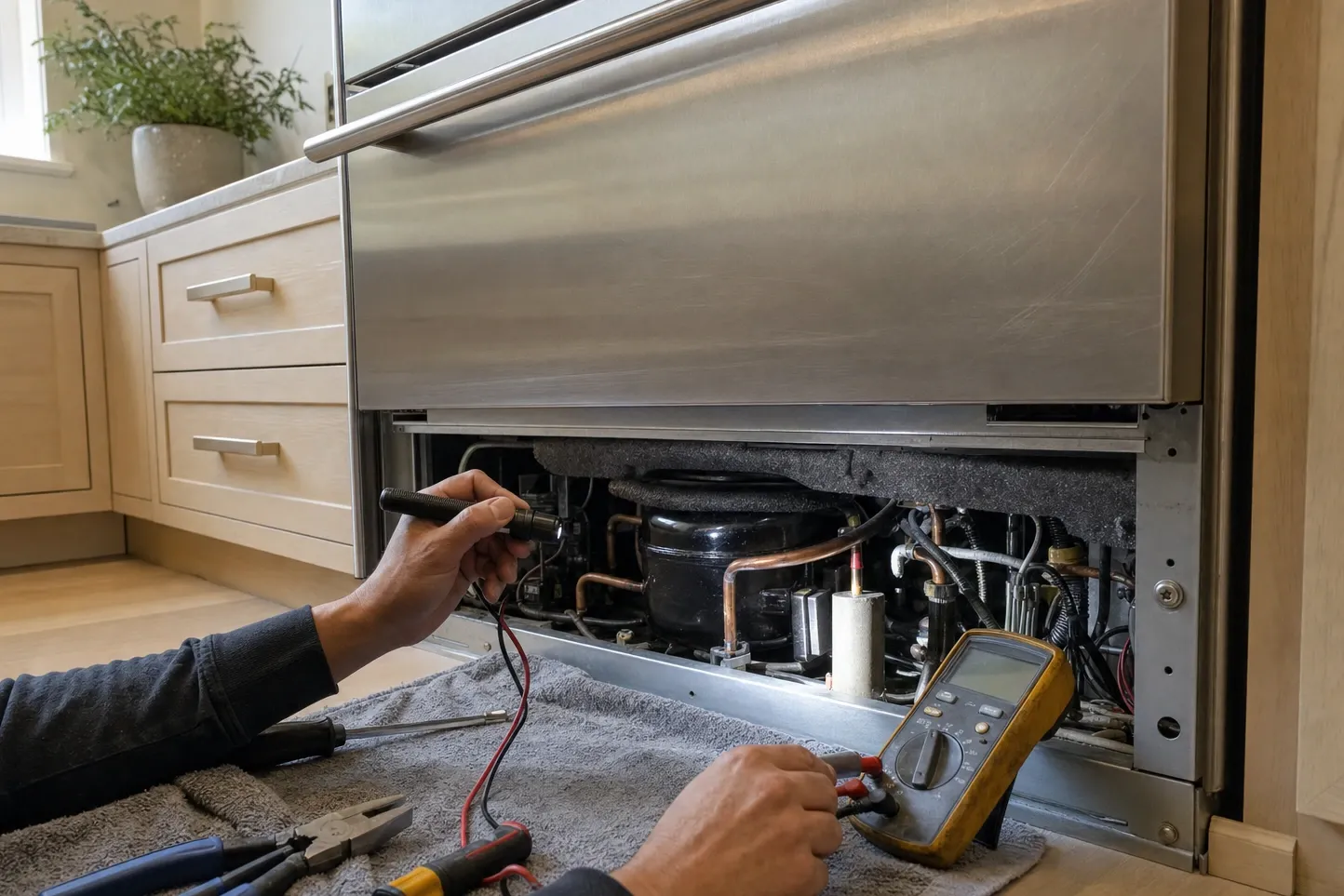
Los Angeles has a formal planning term for the streets much of Silver Lake and Los Feliz fronts: a Substandard Hillside Limited Street, meaning a hillside street improved to less than the standard width. Below a certain roadway width the city will not permit building or grading on one without discretionary approval. It is a planning rule with a very direct appliance consequence.
The question worth asking first
Before anyone quotes anything on a hillside built-in, the question is not what failed. It is whether the cabinet can stay where it is. Taking a several-hundred-pound unit out of one of these houses and walking a replacement in is frequently the largest single cost in the whole project, and it is a cost the appliance itself never touches.
On the narrowest of these roadways there is nowhere legal to stage a lift-gate truck and no room for an oncoming car to pass while a unit is on a dolly. Above them, the same hillsides are laced with public stairways — the Music Box Steps are the famous one, and they are far from the only one — and a fair number of houses are reached only that way. For those addresses the unit is a hand carry up a public stair, in stages, with a crew.
Studio City and Sherman Oaks flip the arithmetic. Flat streets, driveways, a truck at the kerb: removal there is close to free, so the repair-or-replace calculation genuinely comes out differently on the two sides of the hill.
What shortens an appliance life here specifically
Two things dominate: heat that has nowhere to go, and every tilt the cabinet has ever taken.
In the 1920s Spanish houses of Silver Lake and the Mediterranean kitchens below Griffith Park, the built-in is usually wedged into a narrow original opening that was widened just enough to accept it. That leaves the condenser trying to reject heat into a pocket with almost no clearance above or beside it, in a kitchen that is already the warmest room in the house. Poolside bar units in Studio City have the opposite exposure and the same result — ambient heat sitting on the coil for months at a stretch.
The second factor is handling history. A built-in has to be walked in upright, and it cannot be laid flat without putting oil where oil should not be. Units that have been moved through a stair-street house, sometimes more than once, arrive at us with a history the display never mentions. That is also why, after any unavoidable tilt, the unit stands upright and settles before it is restarted rather than being plugged straight back in.
Reading the machine you already own
Four complaints cover most of what we see, and each points somewhere specific.
A warm fresh-food compartment with a freezer that is still hard is an airflow story, not a compressor story. Either the fresh-food evaporator has iced up, its fan has stalled, or the air damper between compartments is stuck. A compressor running without a break through a hot afternoon is a heat-rejection story: coil condition and clearance first, condenser fan second. Water pooling beneath the crisper drawers is a blocked drain trough. A door that no longer pulls itself shut against the seal is a gasket that has taken a set, or a hinge that has dropped, and it quietly causes all three of the others.
The diagnostic order follows the housing stock. In a wedged opening we check clearance and coil condition before anything else, because that is the most likely cause and the cheapest to prove. Then the evaporator and defrost circuit, then sensors and controls read against a shelf thermometer, and gauges only when the readings genuinely point at charge.
Repair, or start again
On these streets, repair wins far more often than it would on flat ground, because the replacement path carries an access bill nobody mentions in the showroom.
Priced work here falls into six bands, and the whole table is printed on the repair-costs pages rather than quoted in an article: a door gasket or seal at the bottom, fan motors and defrost parts a step above, ice maker and water-valve work across a wider span, an electronic control board higher again, and compressor or sealed-system repair in a band of its own. It is that last band that makes people hesitate — until you add what it takes to bring a new cabinet up a stairway and get the old one down.
There is also a question that has to be answered before replacement is even an option: can the existing unit come out the way it went in? Cabinetry has often been built around it since, door swings have changed, a stair turn has been rebuilt. We measure that on the diagnostic visit, not on delivery day.
What a diagnosis gives you
The visit is $89, and what you get for it is a decision rather than a guess: the actual fault, the parts list, whether the repair can be done in the opening, and if the cabinet has to move, what route it takes and how long it stands before restart.
For a Silver Lake or Los Feliz address, tell us when you book whether the house is reached by a driveway, a shared narrow roadway, or steps from the street, and roughly how many. For Studio City and Sherman Oaks, the model number and the compartment temperatures are enough. The number for that is (310) 496-3358, or book from the link above.
Where this goes next
The hillside blocks this article is about are covered in more detail onthe Silver Lake page.
The fault that most often raises the in-place question at all isa freezer box losing cold, because that is where the repair-or-replace maths gets close.
Whichever way it goes, it starts withthe $89 diagnosis — an access decision made without readings is a guess.
Follow-ups
My house is only reachable by public steps. Can the unit still be repaired?
Yes, and repair in place is precisely what a stair-access house needs. Sealed-system work, fan motors, defrost circuits, boards and seals are all done in the opening. It is replacement rather than repair that gets awkward on a stairway, which is why that question gets settled before any delivery is booked.
Is it safe to lay a built-in down to get it through a narrow doorway?
Not laid flat, no. Tip a sealed system far enough and compressor oil travels where it should not, so the cabinet stands upright and settles before power goes back on. Skipping that wait is a common reason a unit never cools properly again after a move.
Why does the same built-in run constantly over the hill and never did here?
Clearance and coil condition, almost always, rather than the appliance itself. Valley heat sits on a condenser for months, and a cabinet wedged into a tight opening cannot shed it. Clearance, coil loading and condenser fan speed get checked first, and a clean often costs nothing past the diagnosis.