↳ Ice Maker Repair
Hollow, cloudy or fused: what your ice cubes are telling you
A Sub-Zero clear-ice machine writes its diagnosis into the cubes. Hollow shells, half-size cubes, cloudiness and a bin welded into one block are four faults, not one — how to read them, and what Los Angeles water does to the plate. Sub-Zero Repair Experts Los Angeles, (310) 496-3358.
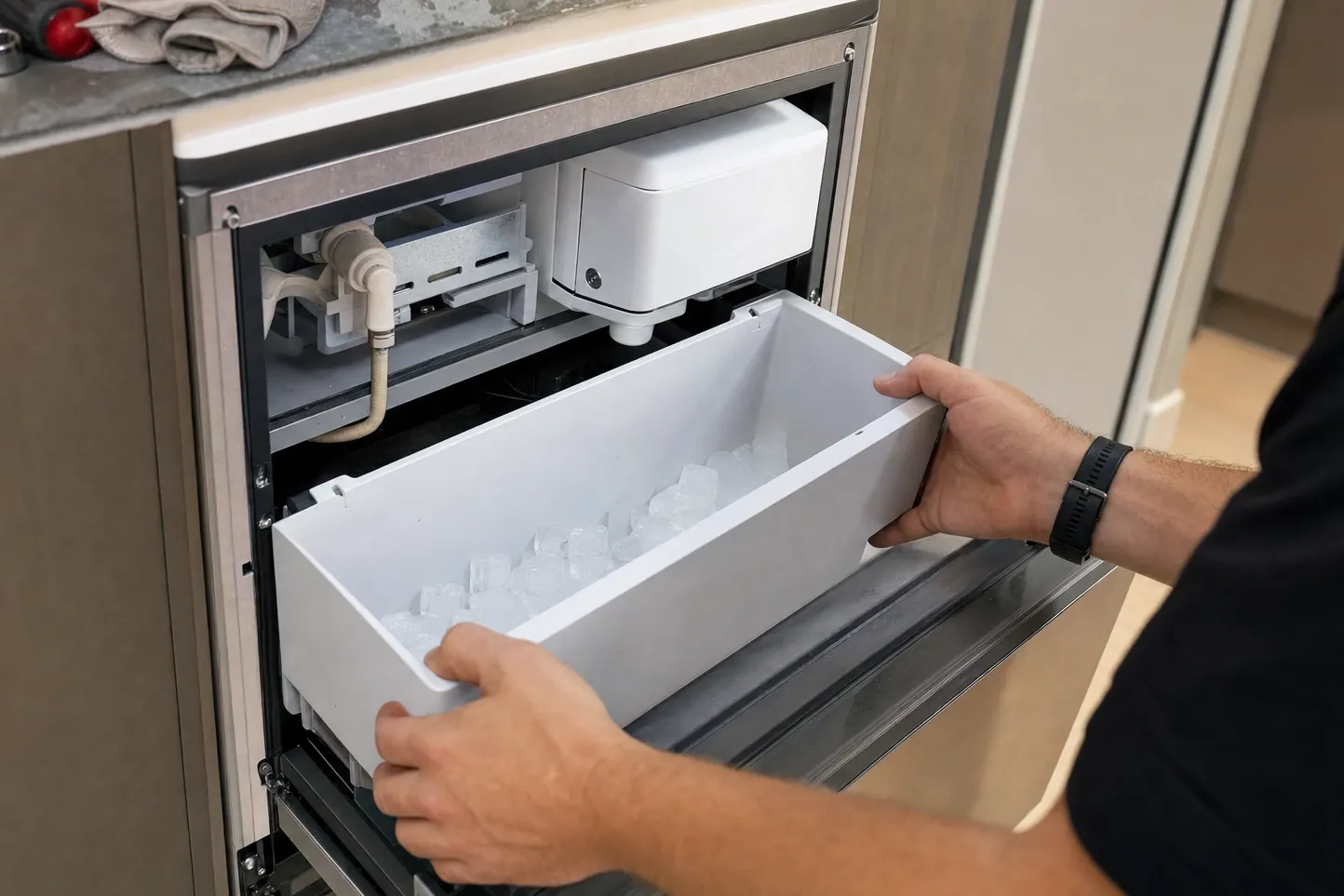
A clear-ice machine is three machines in one box: a small refrigeration circuit, a water system with a pump and a drain, and a timer deciding when to freeze and when to harvest. That is why the cubes themselves are such good evidence. Each of the common faults distorts the cube in its own way, and once you know which distortion you are looking at, the job of finding it is mostly done.
Sub-Zero and the other clear-ice builders make ice by running water continuously over a chilled plate, so it freezes in thin layers and the air and minerals get carried away instead of being trapped. Anything that interrupts that flow, or cuts the cycle short, shows up in the shape and clarity of what lands in the bin.
Four cubes, four faults
| What is in the bin | What it usually is |
|---|---|
| Hollow shells or half-size cubes | Freeze cycle cut short, or water not reaching the whole plate |
| White, cloudy cubes | Scale on the plate, or circulation too weak to carry air away |
| One fused block | Harvest not clearing, or the bin running above freezing |
| No cubes at all | Water supply, inlet valve, pump, or the plate never gets cold |
The last row is the only one that is genuinely ambiguous, and even there the sound tells you a lot. If you can hear water filling and circulating, the water side is doing its job and the cold side is not.
Los Angeles water is the local villain
This is the part that makes ice makers different here from the same machine in a soft-water city. Water across most of the basin is hard, and every gallon that crosses the plate leaves a trace of mineral behind. Scale does two things, both bad: it insulates the plate so the water cannot give up heat properly, and it roughens the surface so cubes cling instead of releasing during harvest.
The result is a machine that has not broken at all but is producing thin, cloudy, half-formed ice, or sticking cubes together in the bin. We see it most in Studio City and Sherman Oaks bar installations, where the machine runs hard through the summer and nobody has cleaned it since it went in.
If you do nothing else with this article, do this: run the cleaning cycle with a proper nickel-safe ice machine descaler, following the interval in your own manual. On unsoftened water here, once or twice a year is realistic. It is the cheapest maintenance in the kitchen and it is the difference between a machine that lasts and one that gets condemned at eight years old.
What you can check yourself
- Confirm water is actually arriving. Find the shut-off under the sink or behind the unit and make sure it is fully open. A valve half closed after a plumbing job starves the fill and gives you thin cubes.
- Change the filter. A clogged filter reduces flow to exactly the point where cubes come out hollow but the machine still appears to run normally.
- Empty the bin completely and look at the plate. A dull, chalky, grey surface is scale. A clean plate is bright metal.
- Check the drain. These machines drain by gravity or a small pump. Water standing in the bottom of the bin means the drain is restricted, and standing water is what welds a bin of loose cubes into one block.
- Give it a full cycle after any of the above. Ice production is slow by nature; judging it after twenty minutes tells you nothing.
What we bring, and what we do
An ice maker call is one of the few where the fix is often maintenance rather than a part, and we would rather tell you that than sell you a pump. On the van for these calls: inlet valves and fittings, circulation pumps, bin thermostats, drain pumps and tubing, and a descaling kit.
On site the sequence runs: water pressure and supply, then the inlet valve, then the pump and the state of the plate, then the harvest cycle and the bin thermostat, and finally the small sealed system if the plate genuinely will not get cold. Undercounter units usually have to come out to see where water is starting, because water never pools where it begins — on a level floor it will travel the length of the cabinet first.
One flat $89 buys the trip and every one of those readings, and it comes straight off the work once you have approved a figure.
When it is worth calling someone
Call when there is no ice at all and the water supply is definitely on, when water is appearing on the floor, or when a descale and a filter have not fixed thin or cloudy cubes. Those are pump, valve, control or sealed-system faults and they need meters.
Hold off if you have not yet cleaned the machine, or if the bin was simply emptied faster than the machine can refill it — a built-in clear-ice unit makes a modest amount of ice per day by design, and a party will outrun it. That is not a fault, and no repair will change it.
Where this goes next
When the module itself is the part that has failed rather than the water reaching it, seewhat an ice maker replacement costs.
A machine filling but never freezing is often the valve in front of it —the inlet valve page puts a figure on that one.
And if the ice is ending up welded to the freezer floor instead of in the bin, that isan ice slab on the freezer floor, which is a drain fault.
Follow-ups
Is cloudy ice unsafe to use?
No. Cloudiness is trapped air and dissolved minerals, not contamination. It tells you the freeze cycle is running too fast or the water is not circulating over the whole plate, which is a performance fault rather than a health one. It is still worth fixing, because the same cause usually reduces how much ice you get.
How often does one of these actually need descaling?
On unsoftened Los Angeles water, most machines want cleaning once or twice a year, and a bar machine that runs hard in summer may want it more often. Scale on the plate is the single most common reason a healthy ice maker stops making decent cubes.
The bin is empty but I can hear water running. What is that?
The machine is filling and circulating, so the water side is probably fine and the freeze side is not. That points at the plate not getting cold enough, a circulation pump moving water but not over the plate, or a harvest cycle that dumps water before it has frozen. It is worth a call rather than more waiting.